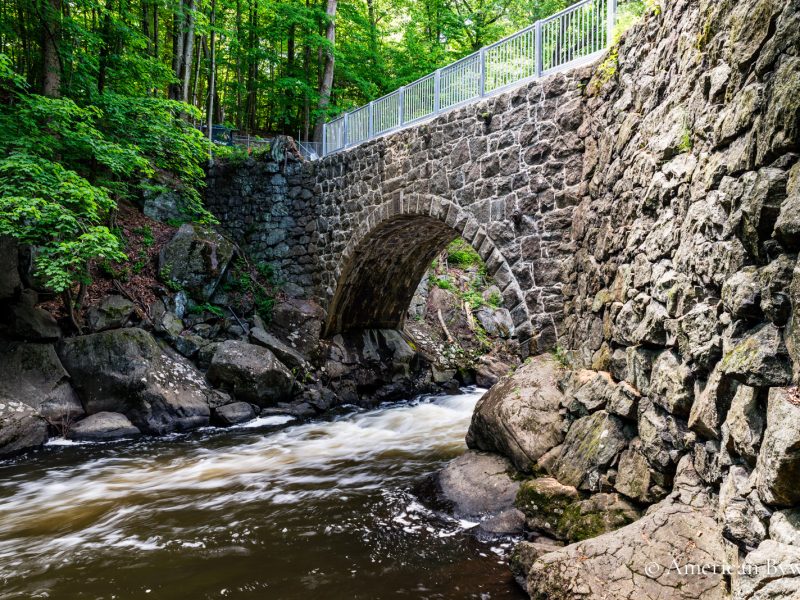
Henry Clay Iron Furnace


West Virginia
Sandstone cliffs, forest trails, and broad views over the Cheat River Gorge.
Coopers Rock State Forest lies roughly 15 miles east of Morgantown, overlooking the Cheat River Gorge and offering some of the most recognizable scenery in West Virginia. The forest is known for its dramatic canyon overlooks, broad sandstone cliffs, and a network of nearly 50 miles of hiking and biking trails that wind through hardwood forests and along ridgetops. Historic features, including remnants of an iron furnace, are scattered throughout the park.
Outdoor recreation defines the Coopers Rock experience. The forest’s exposed sandstone formations attract climbers and boulderers, while the trail system supports hiking, mountain biking, and cross-country skiing in winter. Licensed hunting is permitted in season, and anglers can pursue trout fishing in designated streams and ponds. Scenic overlooks, such as Coopers Rock, provide sweeping views that have long made the forest a destination.
Overnight options range from rustic to comfortable. The Rhododendron Campground offers primitive tent and hammock sites beneath a dense canopy, well-suited for quiet nights and stargazing. For those who prefer modern amenities, the McCollum Campground offers developed campsites with easier access and more facilities.
Coopers Rock State Forest took its name from Coopers Rock, a series of prominent sandstone cliffs overlooking the Cheat River Gorge. Local legend held that a fugitive once hid near what later became the main overlook. Trained as a cooper, he was said to have supported himself by making and selling barrels from his mountain refuge.
Near the forest is the Henry Clay Furnace, the first steam-powered blast furnace in western Virginia. Construction began in 1834, and the furnace entered operation in 1836. Fueled by charcoal and supplied with a cold-air blast from a blowing engine, it produced about four tons of pig iron per day at peak output. Roughly 200 workers were employed at the site, and a small company town emerged nearby, consisting of approximately 100 houses, a store, a church, and a school. Until 1845, iron from the furnace was floated down the Cheat River for shipment. Operations ended in 1847.
The forest itself was established in 1936, when the West Virginia Conservation Commission purchased 12,863 acres from the Lake Lynn Lumber & Supply Company. Many of the park’s early structures, including the main overlook, picnic shelters, and the superintendent’s house, were constructed by the Civilian Conservation Corps during the Great Depression. Eleven of these structures were later listed on the National Register of Historic Places.
Coopers Rock State Forest offers both cabin and camping options for overnight stays above the Cheat River Gorge. The forest’s stargazing cabins are open year-round and include two bedrooms, full furnishings, Wi-Fi, and a telescope, with several pet-friendly units available. Seasonal camping is divided between McCollum Campground, which has 25 sites with electrical hookups, and Rhododendron Campground, which offers 25 primitive campsites beneath the forest canopy.
Coopers Rock State Forest has nearly 50 miles of trails that move through hardwood forest, sandstone terrain, and ridgetop overlooks above the Cheat River Gorge. Routes range from short, easy walks to more moderate hikes and bike-friendly corridors, allowing visitors to tailor the experience to season, distance, and difficulty. Several trails also connect to the forest’s historic landscape, including the Clay Furnace Trail, which leads to a stone iron furnace once used in 19th-century production.
Current conditions near Ices Ferry, West Virginia.