New York
A 115-foot tiered waterfall on Big Stream at Glenora, New York, once the heart of a milling hamlet called Big Stream
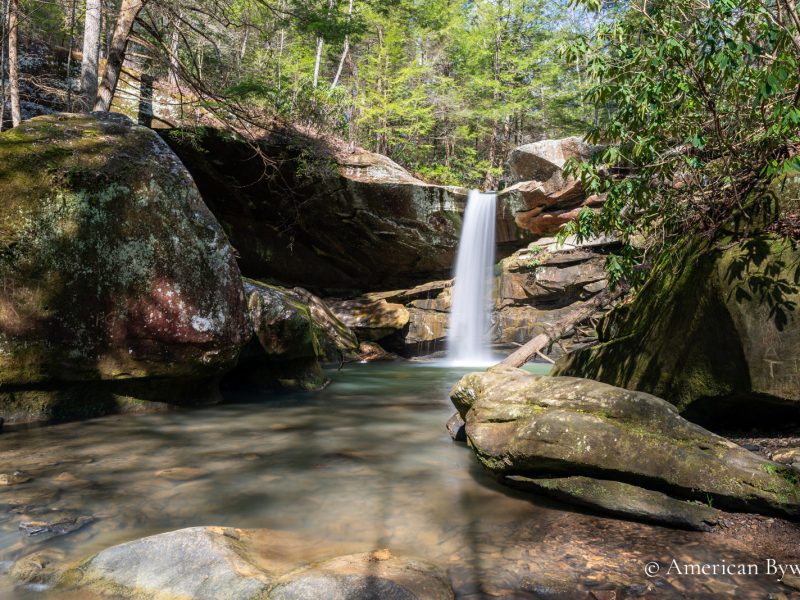
Glenora Falls drops about 115 feet down a cliff face at Glenora Point, fanning as it falls and gathering in a deep plunge pool at the base. Cliffs rise on either side of the main drop, and two smaller tiers sit back in the cleft above, a step of roughly 30 feet and a cascade of about 10 feet. The water arrives by way of Big Stream, which rises some seven miles west at Crystal Spring, in the Crystal Valley of the town of Barrington. It runs northeast to Dundee, turns southeast, and cuts a gorge on its final descent toward Seneca Lake. Glenora Falls is the last of a string of waterfalls in that gully.
The falls stands on private ground and appears to have done so as far back as the record runs. The property around the plunge pool belongs to The Glenora Falls, a rental cottage and wedding venue, and visitors who are not guests of the house see the falls from the roadside on Glenora Road, which leaves State Route 14 at either end and loops down to the lake. There is no parking and no public path to the base.
Settlement reached this stretch of the lakeshore late. A scouting party sent out during General Sullivan’s campaign against the Iroquois in 1779 reported an occupied cabin north of the present hamlet, but the town of Starkey was not settled until around the close of the century, and the steep ground at the mouth of Big Stream stayed empty longer than the farmland on the slopes above it. Yates County was organized in 1823, and Starkey was annexed to it from Steuben County soon after. Big Stream ranked among the streams that supplied the county’s earliest water power, and the ground at its mouth came to be called Big Stream Point.
Larmon G. Townsend came from Connecticut about 1829 and spent the next four decades building up the works at the point. A grist mill stood above the falls and a sawmill below, and by the middle of the century Townsend’s name was attached to both, along with a store and a woolen factory. A second grist mill went up later, upstream near the line of present-day NY-14. A manufacturer of cattle restraints operated from the point, as did a factory turning out boxes for grapes and other produce. Townsend died in 1870 at about seventy, having lately removed to Geneva, and the concerns he had assembled did not long outlast him. By the 1890s they were finished.
What followed was tourism. Houses and shops became cottage rentals, a hotel operated for a time, and the falls found its way into brochures, postcards, and travel accounts. The mill race contributed a second waterfall of its own, spilling over the cliff beside the natural one and drawing visitors under the name Mystic Falls. It survived well into the twentieth century. A notch cut in the top of the cliff is all that remains of it today. The commercial buildings of the point came down in the twentieth century and cottages replaced them, though several houses from the 1800s still stand, among them 77 Glenora Road, built in 1827. The estate house at the falls dates to 1900. The hamlet appears to have taken the name Glenora during the shift to tourism, and the circumstances of the change have not been traced.
Glenora Falls drops about 75 feet down a cliff face at Glenora Point, fanning as it falls and gathering in a deep plunge pool at the base. Two smaller tiers sit back in the cleft above, a step of roughly 30 feet and a cascade of about ten.
Current conditions near Dundee, New York.